Project background
Ni-Vanuatu society is founded on strong family and kinship networks which together with the church have traditionally provided the social safety net for the most disadvantaged and vulnerable. Vanuatu has changed dramatically over the last two hundred years, initially with the arrival of church missionaries and European traders, followed by colonisation, independence and then globalisation.
Protecting children from abuse, violence, neglect and exploitation is an issue needing urgent attention in Vanuatu. Research underpinning the Child Protection Program design reveals the prevalence of child abuse across the country and identifies some of the contributing factors. These are further compounded in some communities, as the traditional family and Kastom support systems are challenged. So while traditional and Kastom systems are adapting to fit a modern world, these adaptations may not meet the basic human rights needs of the population.
In the second half of 2014, the overarching CP Program for Save the Children in Vanuatu, which encompasses the Footprints funded, underwent some restructuring to focus our work on the continuum of care from community to national policy.
Project impact
Specific Activities that were conducted towards the achievement of this project’s objectives included:
Trained 44 students of the Australia-Pacific Technical College in their graduating semester. These graduates were studying to become either Kindi teachers or Youth Development workers and this training was the first time that CP awareness had been included within their curricula.
In co-operation with CARE, Save the Children successfully advocated for the Vanuatu Humanitarian Team to create a ‘Protection Cluster’ that will provide guidance on Child Protection and safeguarding issues in times of disaster. It is envisioned that this Cluster will work closely with the Education and Health Clusters and the National Disaster Management Office to ensure that children are provided safe environments and protected from neglect or abuse following natural hazards.
Selecting community schools for intense positive discipline mentoring and coaching over the coming 2 years in Santo and Ambae islands.
Conducted a 2 day workshop with Vila East primary school focusing on child safeguarding and policy development.
Overall, these initiatives have fed into the work that Save the Children is conducting to strengthen Child Protection systems throughout Vanuatu. As highlighted previously, the language of Child Protection is new to many strata of ni-Vanuatu society so much of the work focuses on creating spaces in which to have conversations with various parts of the community. By facilitating this dialogue simultaneously with national and provincial governments, children, future leaders, teachers, parents, chiefs and members of various organisations and institutions, we are expecting to see a significant increase in the function and performance of child protection systems in the coming years
Mostly, the reception to this work has been positive among the various groups of participants despite the obvious sensitivity of some of the issues involved.
The work that is planned for 2015 will focus on very targeted and high-quality mentoring for a smaller number of communities, as well as training and support for five organisations that work with children and strong advocacy at the national level through the Child Protection Working Group.
What next?
The project is scheduled to continue into and through 2015. In aiming to affect real and positive change for students and schools, two Community Engagement Officers will both begin working closely with two communities each. They will both be responsible for working directly with students, parents, teachers and school administrators and will provide targeted trainings and materials to these various stakeholders. The content of these tools is currently being developed with technical input being provided by Save the Children Australia Child Protection experts. The close and ongoing relationship that these Community Engagement Officers will foster with their respective communities is a novel aspect of this approach.
Can I visit the project?
Due to the geographical separation of project sites from Port Vila, the sensitive nature of the project and the involvement of children, visits would not be appropriate.
Project aims and outcomes:
Children are better protected by teachers and education leaders, who have the skills and knowledge to nurture children, support their development and prevent child abuse.
Objectives:
- To ensure targeted teachers have the skills, confidence and knowledge to be able to use Positive Discipline methods in their classrooms;
- To support education leaders to develop and deliver strategies that will end the use of corporal punishment in schools;
- To ensure children are participating in the design, implementation and feedback of the project.
Outcomes:
- Teachers, parents and education leaders understand the negative impacts of violence on children;
- Targeted teachers are using the skills and strategies consistent with a Positive Discipline approach in the classroom;
- Children reporting fewer incidents of violence in the classroom;
- Quality research enabling the measurement of changes in knowledge, attitudes and practice as a result of program interventions;
- Schools and teachers learning from a portfolio of best practice ‘model schools’ and teacher ‘champions’ who are advocating on Positive Discipline directly with other teachers.
The project cost will cover:
- The research and development of the Positive Discipline project, with the participation of children, teachers and government in Shefa and Penama provinces.
- A baseline survey assessing teacher’s existing knowledge, attitudes and practice will be carried out, along with a training needs analysis. This evidence will inform the development of pre-service training for teachers and input into curriculum development on Positive Discipline methods that will ultimately be rolled out across Vanuatu.
Background on Child protection in Vanuatu:
Protecting children from abuse, violence and neglect is an issue needing urgent attention in Vanuatu. Many children are loved in Vanuatu and highly valued as the future of their country. However a plethora of research now reveals that child abuse is widespread and traditional family and custom values are being steadily eroded as the country grapples with the challenges of a cash economy.
Schools should be safe havens for these children. However despite the ban on corporal punishment it is still widely practiced – including in kindergartens and primary schools - and name calling and bullying are also commonplace. Teachers are under-resourced, under-trained and overwhelmed. Many want to change the way they teach but they don’t know how.
Following a program working with schools that was previously funded by Footprints, significant momentum and ownership has now been generated with teachers and education leaders. The Save the Children team is regularly being asked by teachers for more help and the Minimum Standards in Education offer a strategic opportunity to reach teachers and schools across Vanuatu and link across other programs and sectors. Save the Children in Vanuatu also has island based teams of staff who can directly reach children and support teachers in Vanuatu's most vulnerable and remote rural communities.
Project partners/community involvement:
“If I didn’t use corporal punishment how should I discipline my students? What can you give us to do this?”
Quote from a teacher in Sarakata school following a Footprints funded child protection workshop in 2011.
“My teachers really need this training to be more equipped for child protection issues. There are lots of child abuses in this school, teachers to students and students to teachers and we need your help. Now that we have a finalised child protection policy my worry is how we get this across to teachers so they implement this policy. I believe that if you train these teachers they will protect children and handle them differently in the classroom.”
Headmistress, Shefa Province.
Educators and children: For the past two years Save the Children in Vanuatu, with support from Footprints, has been working in partnership with schools, students and education leaders to better protect children in schools. Despite their limited resources and challenging working conditions, teachers have been willing to change their approaches if given practical support and alternative tools, and as the quote above illustrates, have been directly asking us for deeper support. Students are also slowly becoming more vocal about their needs. Many of the teachers we have worked with have become highly motivated to educate others in their communities about how better to protect children. Community leaders such as pastors and chiefs sit on School Councils enabling the contribution of many voices to the program.
Government: Informed by our work with schools, Save the Children has been supporting Vanuatu’s Ministry of Education to develop Minimum Standards in Education. This means that ultimately every school in Vanuatu will be expected to develop and implement a ‘Safe School Policy’. If these policies are to become more than a piece of paper and make real changes to children’s lives then teachers will need new skills and knowledge to make changes in their classrooms as well as knowing how to identify and help children suffering from abuse at home. The project specifically targets schools in Shefa and Penama provinces because this is where the minimum standards will first be rolled out.
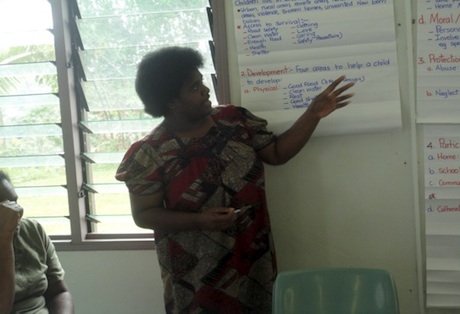
Photo: A teacher from Shefa Province talks about child development needs during a Save the Children child protection workshop in October 2011 as part of the Footprints funded project.
Part of a larger project
In addition to the project supporting the roll out of the Minimum Standards in Education as outlined above, the program fits with a new child protection program being implemented in partnership with the Vanuatu Ministry of Justice. This supports communities to develop and implement their own child safety plans. Teachers will play a critical role in developing and implementing these safety plans as schools are often the hubs of communities. Key issues identified by communities will be fed up to the national Child Protection Working Group to inform policy and ensure that child protection resources are being directed to the right places and used in the correct way.