Overview
This project provided training courses for HIV health workers to improve health care access and enforce legal protections, supplying educational materials and supporting hospital based services for people living with HIV/Aids (PLHIV) in 8 hospitals in Hanoi, Ho Chi Minh, Quang Ninh and Thanh Hoah districts.
Stigma and discrimination is the main obstacle for people living with HIV/Aids to access public health care and education services and needs to be addresses through changes to discriminatory attitude and behaviours.
Changes to discriminatory attitude and behaviours were needed if discrimination and exclusion were to ever be addressed, and vulnerable people empowered to represent their needs and concerns.
This was the third and final year of the project run by CARE Australia. Following this, the hospitals will take over their own ongoing training/support programs for HIV/Aids prevention and care. Through better understanding of their legal entitlements, community groups will be better placed to pursue discussions with local Government staff and policy makers.
Project Outcomes
1. Workshops run for community based groups who support people living with HIV/Aids to increase their awareness of their legal rights and responsibilities regarding both healthcare and access to education.
2. Increased capacity and awareness of healthcare workers at the municipal to fulfill their responsibilities, including confidentiality, quality care for adult people living with HIV/Aids and orphans and vulnerable children, and universal precautions.
3. Support of the 'HIV Friendly corner' in three of Hanoi's district and municipal hospitals as they promote the daily direct contact and interaction between health staff and people living with HIV/Aids.
This serves to further break down stigma and discrimination and also provides important access point to educational materials to improve quality of life.
5. Education materials reviewed, adapted and reprinted education to support campaigns about legal entitlements as outlined by the Government of Vietnam for people living with HIV/Aids and also orphans and vulnerable children.
Conclusion / General Project Comments
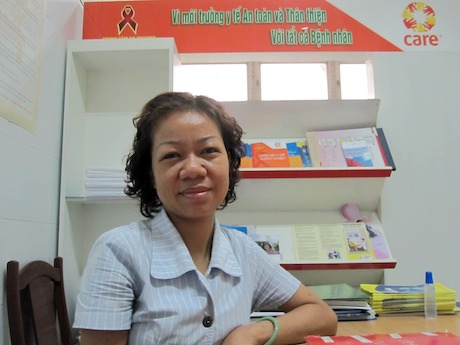
The HIV Friendly Corner initiated by CARE VietNam, aimed to reduce stigma and discrimination against PLHIV in healthcare facilities. This model is one of three main interventions of the CREATE project.
Under this project framework, the model was piloted in three hospitals in Hanoi, namely Hanoi Obstetric Hospital, Thanh Nhan General Hospital, and Hoe Nhai Semi-Public Hospital. During that period, the three Friendly Corners provided counseling to approximately 10,000 clients, of whom more than 6,000 visits were recorded at the Hanoi Obstetric Hospital. Furthermore, the Friendly Corners distributed thousands of informational materials on HIV/AIDS, mother-to-child HIV transmission prevention, and other information materials on rights and obligations of PLHIV.
This model has helped not only to disseminate information and knowledge on HIV/AIDS for people in the community but also to make hospitals friendlier to HIV patients.
With the initial encouraging results recorded and the funds provided by the Footprints Network, CARE VN maintained this model from December 2009 to April 2010.
In addition, from May 2010 to September 2011, with the financial support from the Footprints Network and the Japan International Cooperation Agency, CARE VN replicated this model in other hospitals in Hanoi and Ho Chi Minh city (HCMC) through the DOI THOAI project.
Through this model and many other interventions on HIV/AIDS, CARE VN has been responding to the essential needs of PLHIV, upholding basic rights of PLHIV, and contributing to a better life for PLHIV in Vietnam.
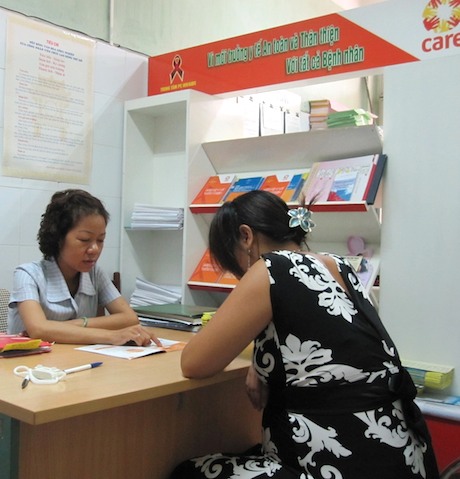
Ms. Trinh Thuy Ngan talking with a client at the Friendly Corner in the Obstetric Hospital, Hanoi
Project volunteer statement
Below are some words from Ms. Trinh Thuy Ngan, the vice head of the Dove group, a self-help group of people living with HIV (PLHIV) based in Thanh Xuan, Hanoi. She has been working as a volunteer at the HIV/AIDS Friendly Corner located in the Obstetric Hospital of Hanoi since July 2008, when this model was initially piloted in this hospital.
“I have never imagined that I would be able to accomplish the work. But the more I work, the more I come to love it. And now these work have become an indispensable part of my life”
“this work gives me the opportunity to help many people. When I can help someone in the same situation and make them live happily again, then I feel very happy and find my life more meaningful.”
“When I talk with the clients, they are often very open and friendly. Perhaps, being in the same situation enables us to share our feelings and thus understand each other. The medical doctors in the hospital often have a large number of patients, receiving 60 to 80 patients per day on average, so they find very little time, if any, to talk to their patients. When I am working at this corner, however, I can help the friends faced with similar challenges as mine and to reduce the workload of the medical doctors”.
Ms. Trinh Thuy Ngan, the vice head of the Dove group, a self-help group of people living with HIV
This project will provide training courses for HIV health workers to improve health care access and enforce legal protections, supply educational materials and support hospital based services for people living with HIV/Aids in 8 hospitals in Hanoi, Ho Chi Minh, Quang Ninh and Thanh Hoah districts. Stigma and discrimination is the main obstacle for people living with HIV/Aids to access public health care and education services and needs to be addresses through changes to discriminatory attitude and behaviours.
Project partners
This project works with a wide range of groups to deliver the project objectives including community-based support groups, hospital based healthcare workers, people living with HIV/Aids and the Vietnam Institute of Human Rights.
Project activities, objectives and outcomes
1. Run workshops for community based groups who support people living with HIV/Aids to increase their awareness of their legal rights and responsibilities regarding both healthcare and access to education.
2. Work with the Preventive AIDS Centers of Ha Noi and HCMC, to increase the capacity and awareness of healthcare workers at the municipal and district levels to fulfill their responsibilities, including confidentiality, quality care for adult people living with HIV/Aids and orphans and vulnerable children, and universal precautions.
3. Support the 'HIV Friendly corner' in three of Hanoi's district and municipal hospitals as they promote the daily direct contact and interaction between health staff and people living with HIV/Aids.
This serves to further break down stigma and discrimination and also provides important access point to educational materials to improve quality of life.
4. Review, adapt and reprint education and communication materials that support campaigns about legal entitlements as outlined by the Government of Vietnam for people living with HIV/Aids and also orphans and vulnerable children.
Project background:
According to UNAIDS, 33.2 million people worldwide were living with HIV
in 2007. Approximately one person in every 60 households in Vietnam
lives with the virus.
While Vietnam is facing a rising number of HIV infections, stigma and discrimination against PLHIV still remains and is the main obstacle for people living with HIV/Aids and orphans and vulnerable children to access public health care and education services.
Changes to discriminatory attitude and behaviours are needed if discrimination and exclusion are to be addressed, and vulnerable people empowered to represent their needs and concerns.
This is the third and final year of the project run by CARE Australia. Following this, the hospitals will take over their own ongoing training/support programs for HIV/Aids prevention and care. Through better understanding of their legal entitlements, community groups will be better placed to pursue discussions with local Government staff and policy makers.