Project Overview
Chadiza district’s population is largely dependent on subsistence agriculture based around maize cultivation, with some livestock grazing on common lands. Erratic rainfall, mono-cropping (maize), poor farming methods, inadequate household labour and a lack of agricultural inputs often result in household food shortage. The most food insecure households in project wards experienced an average of 4.6 months of food shortage between October 2008 and September 2009. Apart from eating fewer meals, affected households coped by eating wild fruits, asking for food from neighbours and extended family, engaging in day labour to acquire food, and in extreme cases, collecting chaff off local hammer mill floors.
Community consultation
Community surveys and verification exercises undertaken in September 2009 resulted in the identification of 150 of the most food insecure households in Naviruli, Chilenga and Nsadzu wards. Project staff and implementing partners conducted further consultations with selected households to finalise training and input requirements. This allowed Plan Zambia project staff, together with Heifer International and Ministry of Agriculture and Cooperatives (MACO) personnel to develop tailored support packages that reflect the needs and capacities of the most food insecure households or household groups across project wards.

Plan Zambia project staff and community verification team members review household survey forms. Verification processes helped to identify the most food insecure households in project areas.
Support & training
Support packages include a mix of community-based training and ongoing mentoring in sustainable farming methods and small livestock-keeping. Plan Zambia will also provide tailored inputs that are in line with household situations and local options, including horticultural and field crop seed, foot-powered irrigation equipment and goats. Heifer International will train selected households in small livestock-rearing and provide ongoing mentoring to support animal health and goat reproduction.
During the reporting period, MACO staff provided additional training to agricultural extension volunteers at the ward level who have since commenced farmer trainings with project households. Project inputs and seeds have all been procured and will be distributed once farmer trainings conclude.
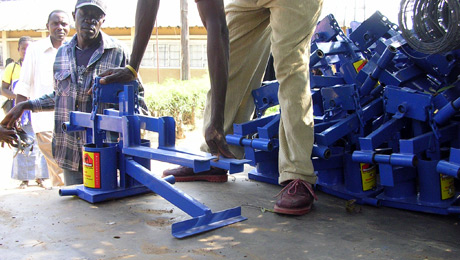
Foot-powered irrigation pumps being unloaded at the Farmers Training Centre in Chadiza Town. Also called ‘treadle pumps’, they are light weight, mobile, completely manual and can draw water from a depth of 7 metres. Pump kits include hoses, simple user manuals and replaceable piston rubber cups.
Future of the Project
Plan Zambia, MACO and Heifer International staff will complete all trainings and provision of tailored inputs to project households. Trainings and inputs will support:
- Field crop production, including drought resistant crops
- Off-season production of vegetables, fruit and beans, and
- Small livestock rearing.
Households unable to adequately capitalise on these supports will be linked with local community-based organisations engaged in livelihoods and home-based care. Community members, MACO, Heifer and Plan Zambia/Australia will undertake follow-up surveys and interviews with project households ahead of a stakeholder reflection workshop to be held in August 2010.
Reporting Period
This report covers the period from October 2009 to March 2010. A
follow-up report in September 2010 will provide further insight into how
Footprints funds have Improved the food security amongst the poorest
families in Zambia.
Your donation to this project will help cover costs for
Plan will work with implementing partners to provide tailored support ‘packages’ that best meet the needs and capacities of participating farming households. Support packages may include some or all of the following:
- training in improved farming methods
- horticultural inputs such as field crop and garden seeds
- irrigation equipment, small livestock such as goats
- training in goat-rearing techniques and animal health.
This Footprints funded project is a part of Plan Australia’s comprehensive Improving Food Security Among Poorest Families in Zambia (see full details below)
Project Aims/Outputs
- In 2010, Plan in Australia will support Plan Zambia, local partners and communities in Chadiza District to identify and assist approximately 180 households which are among the most food insecure to:
- Develop a range of locally available livelihood support 'packages' that are suited to each household’s composition and capacities;
- Promote off-season vegetable gardening, improved farming methods, cereal crop production, increased crop diversification, poultry and small livestock rearing;
- Work with local government and community groups to provide tailored community-based trainings, inputs (including seed) and ongoing mentoring to help sustain adequate household food supplies throughout the year;
- Work with community service groups trained through a previous Australian-assisted program to raise awareness of women’s and children’s rights, promote the importance of women’s involvement in household decision-making processes as well as men’s increased involvement in shared labour, and;
- Document project activities and household outcomes in order to inform other food security interventions.
Why is the project needed?
Plan Zambia’s experience in Chadiza district in Eastern province confirms that many rural households continue to experience food shortage. The ‘lean’ or ‘hungry season’ as it’s called lasts from November to February and often forces affected households to eat less food and less variety. In extreme cases, food insecure households sometimes have to beg, sell or exchange assets to access food.
Why improving food security is a priority?
- Inadequate access to nutritious food undermines the health of all household members and can negatively affect child development.
- Promoting diversified and improved household food production helps to strengthen household and community resilience to withstand the effects of erratic rainfall, family illness, the loss of family members and sudden increases in the cost of living.
- Sufficient access to food, including surpluses, can safeguard and even increase household asset bases, and can lead to improved quality of life.
- Sale of surplus crops can be used to further improve farming, pay school fees and support improved household diets.
How Plan is helping to change things
Previous projects in Chadiza District have included the provision of farming inputs, seed and agricultural training to communities. A food access and farming practice survey in October 2008 found that although improvements had occurred in two wards there was still need for further work. The survey identified that 53 percent of households overall, and 56 percent of ‘vulnerable’ households (those with chronically ill, elderly, disabled and/or orphans), had not experienced an increase in the variety and quantity of food produced in the last 3 years. This project will help to further refine which families Plan in Zambia needs to specifically work with to address food insecurity.
Project Partners
Plan is partnering with the Ministry of Agriculture, co-operatives, community-based groups such as agricultural extension volunteers, Heifer International, local leaders and communities.